
“You are most likely to compromise your integrity or breach your boundaries when they are not well established and announced commitments.” – Phil Preneur

People commonly ask me about how I came up with my Coach Code of Honor. When I was five years old an uncle gave me a book about King Arthur and the Knights of the Round Table. My mother had taught me to read the year before; however, the book was a bit beyond my comprehension level at the time. There was a section that fascinated me and that I read periodically until I understood. That section was about their ‘Code of Honor.”
The knights had valor. They were expected to show courage in battle and loyalty to King Arthur. They practiced a code of chivalry and protected women, children, and the defenseless. The Knights were sworn to uphold truth and honor. They swore to uphold justice.
A Coach Code of Honor is a declared standard of conduct that defines how you choose to operate, make decisions, communicate, and lead. An ethos removes guesswork for you and your client.
A code of honor is established boundaries and ethics to guide behavior. A clear code also answers this question: What can clients expect from you?
A Coach Code of Honor gives you the clarity that creates consistency, and consistency builds trust.
Within coaching, a credo serves as both a compass and a filter. When you operate without the boundaries of a code you can be more susceptible to reacting based on mood, pressure, or opportunity. A coach with a code acts from principle and prospects and clients sense and appreciate this.
The benefits of a Coach Code of Honor are practical and immediate. Trust forms faster because expectations are clear. Conversations become more direct because you operate from defined standards rather than vague intentions. Decision-making improves because each choice runs through a set of principles already established. Difficult moments become easier to navigate because the code answers, “What action aligns with who I say I am?”
A Coach Code of Honor also protects reputation. In coaching, reputation grows through consistency over time. One misaligned decision can erode trust built over months or years. Establishing your principles reduces that risk by setting boundaries before pressure appears.
Another benefit involves client selection. Not every client fits every coach. A Code of Honor attracts aligned clients while naturally repelling those who expect shortcuts, manipulation, or unclear commitments. That filtering process strengthens long-term relationships and improves outcomes.
Strong rules of engagement also reinforces personal confidence. When you know exactly what standards guide your behavior, second-guessing decreases. Your conversations are more grounded and recommendations carry more conviction.
A Coach Code of Honor is not a marketing slogan. This is a working document that defines behavior, communication, and decision-making in real situations. Strong established statements answer questions before they arise.

Creating a Coach Code of Honor requires deliberate thinking, honest reflection, and clear language. This process begins with three foundational questions: What do you do? What do you stand for? What do you refuse to do?
Start with what you do. This question goes beyond job description. Focus on outcomes created for clients. Do you guide decision-making? Do you challenge assumptions? Do you help clients clarify direction? Write statements that describe actions and results, not vague intentions. For example: “I help clients identify the root cause of stalled growth and define a clear next step.” Specific language creates clarity.
Next, define what you stand for. This section forms the backbone of your Coach Code of Honor. Choose principles that guide behavior in both easy and difficult situations. Common principles include honesty, clarity, respect, accountability, and long-term thinking. Avoid generic language. Each principle should translate into observable behavior.
For example, honesty becomes: “I tell the truth in every conversation, even when a direct answer creates discomfort.”
Clarity becomes: “I explain ideas in a simple, direct way without unnecessary complexity.”
Accountability becomes: “I take responsibility for every recommendation and outcome connected to my guidance.”
These statements remove ambiguity. A client can read each line and understand exactly what behavior to expect.

Now define what you refuse to do. This step separates strong codes from weak ones. Boundaries matter. Without boundaries, principles lose strength. Consider what actions conflict with your standards. Examples might include refusing to pressure clients into decisions, refusing to recommend solutions that do not fit a client’s situation, refusing to hide risks or downsides.
A powerful Coach Code of Honor includes both commitments and refusals. Commitments show what you will do. Refusals show where you draw the line.
Once these elements are clear, shape the code into concise statements. Aim for strong, direct language. Each statement should stand on its own. Avoid filler words. Avoid abstract phrasing. Each line should feel like a promise.
After drafting, test each statement against real scenarios. Imagine a difficult client conversation. Imagine pressure to close a deal. Imagine a situation where a recommendation may not benefit the client. Does each statement still hold? If any line feels flexible under pressure, rewrite until clarity strengthens.
Consistency matters more than perfection. Your principles must guide behavior daily. Review the code regularly. Refine language as experience grows. A code evolves through real-world application.
A final step involves alignment between words and actions. A Code of Honor only works when behavior matches statements. Every interaction becomes a demonstration of the code. Over time, consistency builds credibility.
A Coach Code of Honor is not created in a single sitting. A strong code develops through reflection, testing, and refinement. The result is a clear, practical standard that guides every client interaction.
A Coach Code of Honor needs to fit your values, principles, and ethics. A strong code comes from deciding, ahead of time, what you stand for and how you will operate in real situations.
Start with a simple question: What role do I play as a coach?
Many coaches describe their work at a surface level of a title: business coach, life coach, leadership coach. Those labels describe a category, not a function. A more accurate description focuses on the impact created.
Examples:
“I help business owners think clearly and make better decisions.”
“I help leaders see blind spots and take decisive action.”
“I help individuals move from confusion to clarity, so progress becomes possible.”
That framing matters. A Coach Code of Honor must align with your purpose and influence, not just a title.
Once your role is clear, the next step involves defining the standards that guide your behavior. These are not statements written to sound good. These are decisions about how to act when situations become difficult or unclear.
Next, define what will not be done. A real Code of Honor draws clear lines.
Establishing your boundaries guides your behavior. Without a clear line, unwanted behaviors can be justified in the moment.
Write the code down. Not for display, but for clarity. Use simple language. If a statement cannot be said naturally in a real conversation, that statement does not belong in a Code of Honor.
A strong code should sound like something you would actually say because in the moments that matter, those words will guide how you show up.
A Coach Code of Honor needs to fit your values, principles, and ethics. A strong code comes from deciding, ahead of time, what you stand for and how you will operate in real situations.
Start with a simple question: What role do I play as a coach?
Many coaches describe their work at a surface level of a title: business coach, life coach, leadership coach. Those labels describe a category, not a function. A more accurate description focuses on the impact created.
Examples:
“I help business owners think clearly and make better decisions.”
“I help leaders see blind spots and take decisive action.”
“I help individuals move from confusion to clarity, so progress becomes possible.”
That framing matters. A Coach Code of Honor must align with your purpose and influence, not just a title.
Once your role is clear, the next step involves defining the standards that guide your behavior. These are not statements written to sound good. These are decisions about how to act when situations become difficult or unclear.
Next, define what will not be done. A real Code of Honor draws clear lines.
Establishing your boundaries guides your behavior. Without a clear line, unwanted behaviors can be justified in the moment.
Write the code down. Not for display, but for clarity. Use simple language. If a statement cannot be said naturally in a real conversation, that statement does not belong in a Code of Honor.
A strong code should sound like something you would actually say because in the moments that matter, those words will guide how you show up.
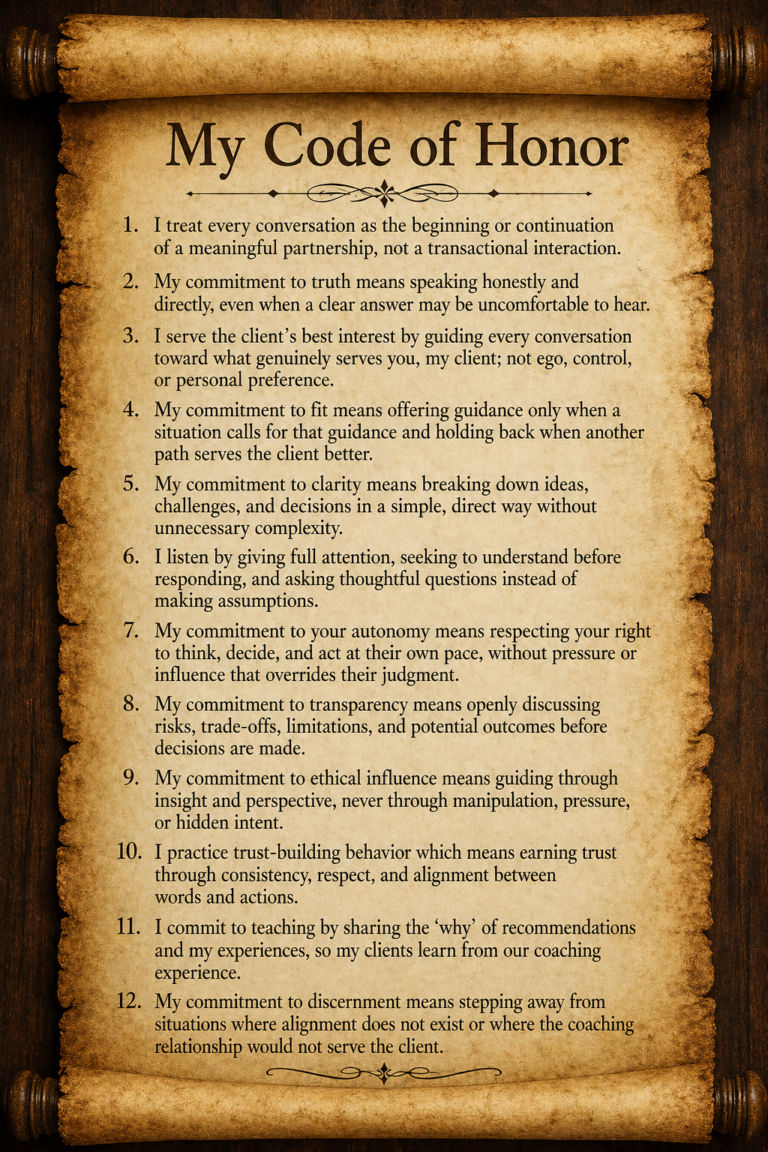
I treat every conversation as the beginning or continuation of a meaningful partnership, not a transactional interaction.
My commitment to truth means speaking honestly and directly, even when a clear answer may be uncomfortable to hear.
I serve the client’s best interest by guiding every conversation toward what genuinely serves you, my client; not ego, control, or personal preference.
My commitment to fit means offering guidance only when a situation calls for that guidance and holding back when another path serves the client better.
My commitment to clarity means breaking down ideas, challenges, and decisions in a simple, direct way without unnecessary complexity.
I listen by giving full attention, seeking to understand before responding, and asking thoughtful questions instead of making assumptions.
My commitment to your autonomy means respecting your right to think, decide, and act at their own pace, without pressure or influence that overrides their judgment.
My commitment to transparency means openly discussing risks, trade-offs, limitations, and potential outcomes before decisions are made.
My commitment to ethical influence means guiding through insight and perspective, never through manipulation, pressure, or hidden intent.
I practice trust-building behavior which means earning trust through consistency, respect, and alignment between words and actions.
I commit to teaching by sharing the ‘why’ of recommendations and my experiences, so my clients learn from our coaching experience.
My commitment to discernment means stepping away from situations where alignment does not exist or where the coaching relationship would not serve the client.
– Phil Preneur

A Coach Code of Honor has more value when others can see, understand, and experience your standards. Be proud of your commitments and display them so people know what you stand for and how they can trust you.
Start with a dedicated page on your website. A clear “Coach Code of Honor” page signals professionalism and transparency. This page should present each commitment in a clean, readable format. Avoid long paragraphs. Use strong statements that stand alone. A visitor should understand your standards within seconds.
A dedicated page also allows prospects to self-select. Some visitors will read the code and feel immediate alignment. Others may recognize a mismatch. Both outcomes are valuable. Alignment leads to stronger relationships, and misalignment saves time for both sides.
Next, integrate your Coach Code of Honor into your About page. Many visitors read this section to understand who you are and how you operate. Including your code here reinforces your identity and values. Rather than describing yourself in general terms, your code demonstrates behavior.
Social media offers another opportunity. Share individual statements from your Code of Honor as posts. Each statement can stand alone as a message about how you approach coaching. Over time, these posts build a consistent narrative. Followers begin to associate your name with specific standards.
Email introductions provide another effective placement. When a new prospect joins your list or schedules a call, include a brief version of your Coach Code of Honor. This sets expectations before the first conversation. A prospect enters the call with a clear understanding of how you operate.
During appointments, reference your Coach Code of Honor directly. At the beginning of a call, you might say, “A few principles guide our conversations,” followed by two or three key statements. This approach builds trust quickly. A prospect understands that the conversation will follow a defined standard.
Include your Coach Code of Honor in proposals or onboarding materials. When a client decides to move forward, presenting your code reinforces the relationship. A client sees a clear commitment to behavior, not just outcomes.
Consistency across all channels matters. Website, email, social media, and live conversations should reflect the same standards. Mixed messages weaken trust. Consistent messaging strengthens credibility.
Another effective approach involves visual presentation. Create a simple, clean graphic that displays your Code of Honor. Use that graphic in presentations, PDFs, or onboarding documents. Visual repetition reinforces memory.
Finally, live your Code of Honor in every interaction. Words introduce the code. Behavior proves the code. A prospect may read your statements once, but that prospect will judge your consistency in every conversation.
A visible, consistently applied Coach Code of Honor becomes a differentiator. Many coaches talk about values, yet few define them clearly. Even fewer demonstrate them consistently. A well-communicated Coach Code of Honor sets a standard that your prospects recognize, and your clients trust and remember.